

Why We Advise Against SEO Optimization via WDF*IDF
WDF*IDF is a method popular among online marketers and copywriters in Germany for optimizing on-page SEO text. It’s a concept that’s been around for more than a decade and revolves around the frequency of (key)words on web pages.
As an online marketing agency, we have our own method for creating SEO text that does not rely on WDF*IDF analysis.
We acknowledge when other marketing professionals succeed with WDF*IDF. However, in this article we briefly outline why WDF*IDF doesn’t convince us on a professional level.
What Is WDF*IDF?
WDF*IDF is a mathematical approach that claims to determine an optimal frequency for all important keywords in an SEO article. This frequency is usually given as an absolute count, or in some variants as a corridor (range).

Example
To make it more tangible, below is a fictional numerical example for a 2,500-word SEO article on the topic “WordPress agency”:
| Keyword | Frequency (absolute) | Frequency (as corridor) |
| WordPress | 60x | 45x–75x |
| WordPress agency | 12x | 9x–15x |
| Development | 8x | 6x–10x |
| Design | 7x | 6x–9x |
| … | … | … |
An online marketer or copywriter would use a list like this to write the article, watching during drafting to include the keyword “WordPress” 60 times, “WordPress agency” 12 times, and so on. Lists of this kind are usually fairly long and therefore include a lot of individual terms.
If corridors are used instead of absolute counts, the article would pass the WDF*IDF SEO check as long as the number of mentions falls within the specified ranges, and could then be published.
Where Do the Numbers Come From, and How Does WDF*IDF Work?
WDF stands for “Within Document Frequency.” It means: How often does a keyword occur in relation to all keywords in the document?
This is its mathematical formula:
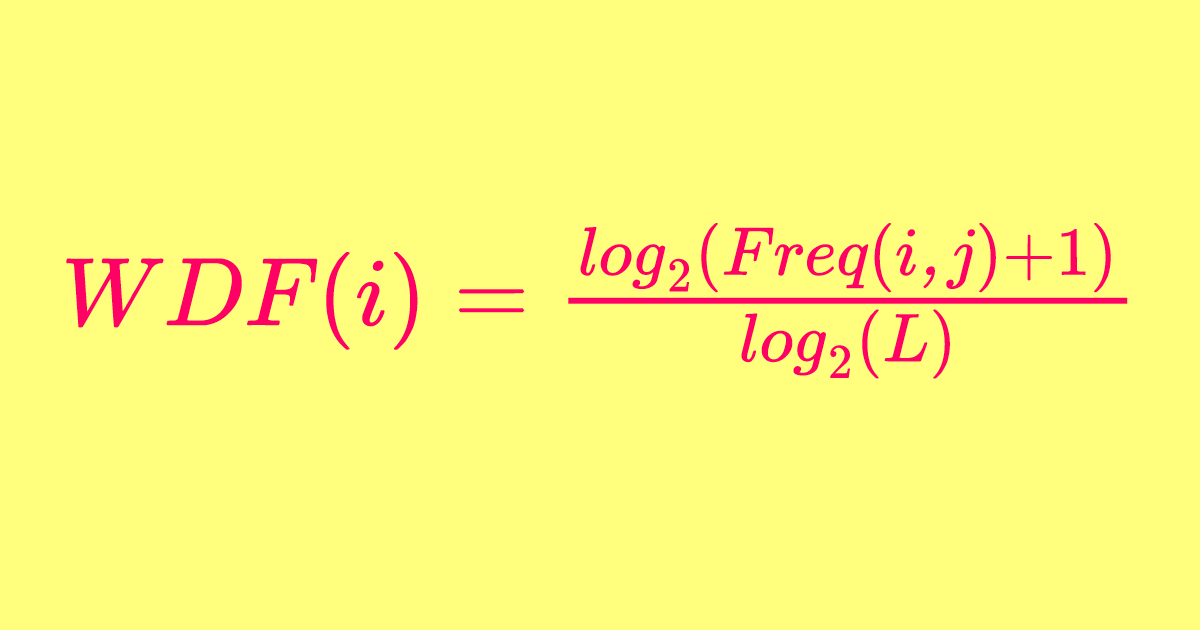
i: Word
j: Document
L: Total number of words in document j
Freq(i,j): Frequency of word i in document j
IDF stands for “Inverse Document Frequency” and acts as a corrective:

ND: Number of documents
ft: Number of documents that contain term t
Words that appear in very many texts (e.g., “and,” “the”) count less; rare, topic-specific terms count more. This highlights the words that truly differentiate a text rather than mere frequency. In combination with WDF, this prevents generic terms from distorting the evaluation and helps prioritize relevant keywords.
WDF and IDF are determined and multiplied to compute a term score/relevance value, from which the recommended word frequency is then derived.
When WDF*IDF became popular in German online marketing in the early 2010s, some users calculated keyword frequencies by hand. The inputs used were competitor texts—that is, texts already ranking on Google for the intended focus keyword (link coming soon).
Today, there are analysis tools that automate or further develop this calculation. One example of a tool that uses an evolved form of WDF*IDF is Surfer.
Surfer even specifies frequency corridors for special placements like headings and bold text, indicating how often certain keywords should appear there.
Our Results with WDF*IDF
We have (re)optimized various web pages using WDF*IDF and/or Surfer.
Our biggest success: For several weeks, we managed to rank our page “svaerm: WordPress agency” on the first page of Google across Germany for the keyword “wordpress agency.” Previously, this page was only visible for search queries from the Frankfurt area.
As a result, the number of project inquiries from prospects looking for a WordPress agency measurably increased.
Why We Still Advise Against WDF*IDF
(Re)optimizing pages like “svaerm: WordPress agency” with WDF*IDF took an entire workweek.
The challenge is to make the text sound natural and credibly signal E-E-A-T (Experience, Expertise, Authoritativeness, and Trustworthiness; link coming soon), even though there is a precise mathematical specification for how often which words should occur.
That requires a high level of copywriting skill, because just ranking on Google isn’t enough—web pages also need to “convert,” i.e. in B2B, generate business inquiries. For a junior copywriter, this is nearly unattainable under such strict constraints. In our experience, even with carefully engineered prompts, AI is not yet at a point (link coming soon) where it can automate or reliably support this process without making significant mistakes or going off topic. So, a senior SEO writer has to handle it, with a considerable investment of resources.

Unfortunately, the success tends to be short-lived: As mentioned, WDF*IDF analysis is based on competitor texts. That’s problematic because Google constantly ranks new pages in its results. Especially in competitive niches, the search results can change by the second.

The recommendations from a WDF*IDF analysis are therefore always just a snapshot and incomplete. While ranking nationwide for a keyword like “wordpress agency” is a good achievement, it’s not economical to invest an entire workweek of a senior SEO copywriter every month to maintain it.
WDF*IDF is probably only worthwhile in particularly static niches with little competition in SEO content marketing—in other words, “blue ocean”. But for such keywords, you usually don’t need a WDF*IDF analysis in the first place because the competition is so low.
What You Can Do Instead
We tailor our recommendations based on your company size:
- For small businesses: Determine the search intent before drafting your text—that is, the information needs your target audiences associate with their Google query. You can use Search Intent Hierarchy Analysis (SIHA) for this. Implemented correctly, this approach ensures that the primary and secondary search intents (link coming soon) are covered, meaning the topic is comprehensively addressed from Google users’ point of view. Then you don’t need a WDF*IDF analysis. If that’s not enough to rank a page, create additional, thematically related pages and interlink them with the first page using a hub-and-spoke approach (link coming soon).
- For mid-sized and large companies: Are you solely or in a small team responsible for your company’s marketing? Then it’s likely not economical to handle all measures and channels in-house by yourselves. If you have to cover SEO, content marketing, web design, website relaunches, social media marketing, email marketing, online PR—and at the same time trade shows, ad campaigns, print marketing, corporate identity, employer branding, and more—you’ve lost the battle before it begins. SEO content marketing has evolved into one of many specialties where, despite decades of focus, you learn something new every day and always compete with other experienced marketers. Therefore, for mid-sized and large companies, it’s advisable to work with an agency that bundles expertise across different specializations.
Conclusion
WDF*IDF illustrates how certain theoretical models can become entrenched in online marketing for a long time without being critically examined for feasibility, scalability, and long-term cost-effectiveness.
SEO content marketing is a dynamic field where conditions and rules can change quickly. That’s why, with Search Intent Hierarchy Analysis, we rely on a method that conceptually focuses on the information needs of target audiences. Unlike keyword frequencies in competitor texts, those needs are not a short-lived superficiality but the key to sustainable SEO success.
Contact for business
svaerm is an online marketing agency based in Frankfurt am Main. We see ourselves as a T-shaped agency—with a broad range of online marketing services (the horizontal bar of the “T”) and deep expertise in SEO content marketing and WordPress (the vertical bar of the “T”). Together with our sister agency Mai Communications, we can also offer offline marketing services and operate as a highly bespoke full-service agency with high quality standards.
Feel free to contact us for an introductory call! After receiving your initial information in writing via the contact form below, we’ll gladly advise you personally by phone, video call, or on site.
