

What does Blue Ocean Strategy mean?
Blue ocean strategy is a business model that avoids or redefines fields saturated with competition. Instead, strategists target blue oceans, or innovative new markets.
The term was coined in 2004 by INSEAD professors W. Chan Kim and Renée Mauborgne to describe businesses able to innovate successfully without access to new technologies.
When a business implements the blue ocean management strategy for a new or existing venture, their goal is to develop a new market that is profitable and sustainable. They do this by offering products and services of lower cost and/or specialized features to untapped markets of previously unserved or underserved customers.
Blue Ocean vs. Red Ocean
Blue oceans are markets with little to no competition. Red oceans are markets saturated with fierce competition over the same products and services.
Blue ocean strategists innovate in product design, rather than waiting for a technological innovation to compete over. They redefine their market, consumer, or relationship to their competitors, cutting unnecessary features and inventing new ones.
Red ocean strategists engage in bloody competition over the same market. Their products and services must outdo each other, which can result in innovation through iteration, higher overall product costs, and additional features that not all consumers may need.
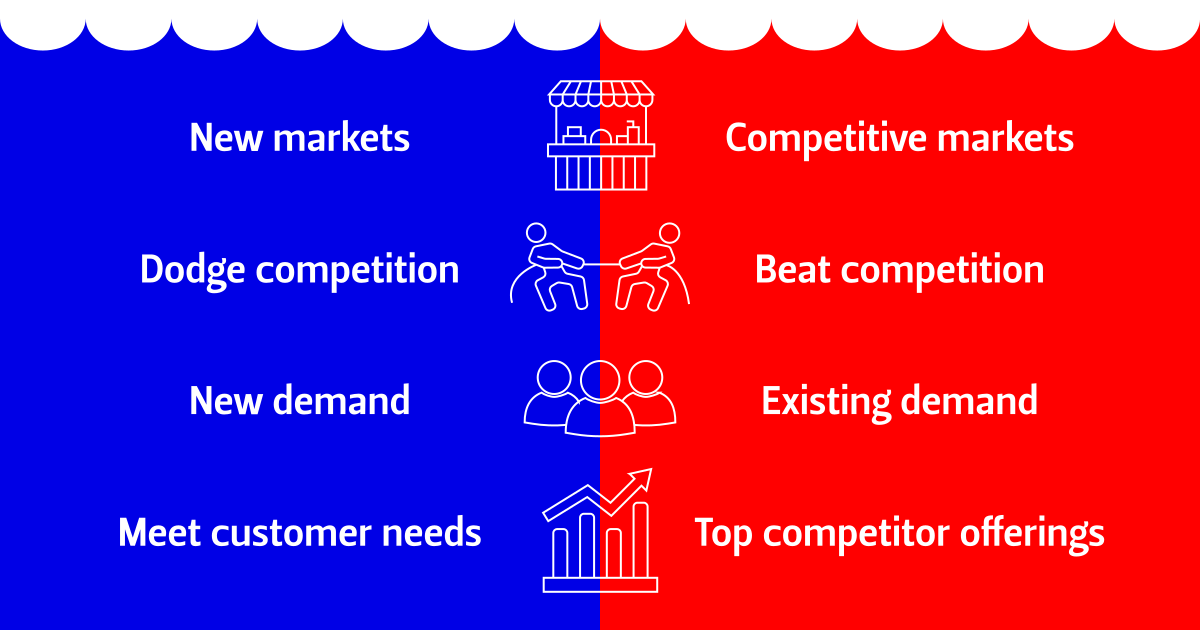
Blue ocean strategy operates on the principle of value innovation. By opening up blue oceans, strategists create value and lower costs for both the customer and the company. Instead of attempting to provide the best product by every metric available, they carefully examine the competition to choose strategic areas in which to differentiate their product.
Blue Ocean Methodology
How is the blue ocean strategy put into practice?
Create a value curve
Start with a value curve. This visual tool is a compact way to compare the strengths and weaknesses of your business against its competition.
First, identify each of the core elements that characterize the business—for both customers and non-customers. What are they considering when they choose your business? What is stopping non-customers from choosing you?
Then, on the X-axis, add each of the core elements you selected. On the Y-axis, you will rate the quality or value of each, from high to low.
Next, rate the value your business offers for each element you added to the X-axis. Connect each point to form a line, or value curve.
Finally, repeat the process to add your current competitors for comparison. Your goal is to be able to visualize, side by side, the potential areas in which you can differentiate or reinvent your product or service.

Analyze the curve
Focus on four questions as you examine your position on the value curve. As you answer them, adjust the curve and see where you can leave the competition behind.
Elimination: What factors are taken for granted and can be eliminated entirely?
Reduction: What can be radically reduced to limit costs and simplify the customer experience?
Increase: What can be raised above the industry standard to attract customers?
Creation: What components can be added to the curve that have never been offered in the market before?
Find the Blue Ocean
Use your new value curve as a basis for a model that has no existing competition. Consider how you will redesign your product or service, connect alternative industries, or differentiate yourself from close competitors within your industry.
Rethink your customer base, not just your product. Consider not just current customers of the industry, but also those who are on the edge of your market, consciously choose against your market, or have never considered your market.
Examples
Many notable businesses have succeeded through the blue ocean strategy.
Netflix broke away from the red ocean of DVD rental companies by ditching its physical options and becoming the first major player to move to the blue ocean of digital streaming. This move simplified the product for consumers, lowered costs, and made the company synonymous with streaming.
Nintendo tapped into the blue ocean of simple and inexpensive gaming products with the Wii, after struggling to compete with the hardware quality of competitors. This pivot launched a dynasty of low-cost, family-oriented consoles that is still going strong today.
Marvel Studios made multiple blue ocean moves to dodge competition, first capitalizing on the popularity of their comic book characters through movies, then connecting their products through a cinematic universe as competitors began to release their own films.
Blue Ocean vs. Red Ocean in SEO
To develop original content that ranks, SEO experts make use of both blue ocean and red ocean strategies. The field of search engine optimization itself is an interesting example of the blue ocean effect in action.
Red Ocean SEO
Many high-traffic keywords are already full of businesses competing for visibility through strategically optimized content. To compete with pages in this red ocean, we use Search Intent Hierarchy Analysis to identify the strengths of successful pages and refine them, improving on existing content to meet search intent. This approach can be time-consuming, but it requires the least subject-matter expertise in the target niche and gives the final product a high chance to rank.
Blue Ocean SEO
Sometimes, our research reveals a keyword that has not yet been optimized for or explained in a way that meets search intent—a blue ocean opportunity. These keywords may have an attractive search volume but few competitive pages, or they may have been overlooked by keyword tools and marketers due to their low organic search volume.
Keywords with few competitors have some existing pages that are usually limited in content or perspective. We can apply Search Intent Hierarchy Analysis to identify the strongest parts of these examples and produce original and holistic content. These pages require careful identification of what makes existing content incomplete, as well as a moderate level of subject-matter expertise in the target niche to accurately fill those gaps.
Keywords with low organic search volume have been overlooked by competitors. These may be underreported and currently unoptimized keywords (offering a traffic opportunity with a low barrier of entry) or highly specific, long-tail keywords that signal the end of a customer journey (offering a higher conversion rate). To create effective content without existing competitors, we base our strategy on Search Intent Hierarchy Analysis results for other topics in the same niche. Although these pages have a good chance to rank, the lack of existing pages to reverse-engineer means that their creation also requires the most subject-matter expertise.
Contact for Business
Looking for a full-service marketing agency that can succeed in both the blue ocean and the red? svaerm is ready to support you, as an SEO agency and more. Submit your initial written inquiry to our agents using the form below to learn more.
